

AUX heat is backup heating that your heat pump system calls for automatically. Emergency Heat is a thermostat mode that normally turns off the outdoor compressor and uses the backup source alone. Seeing AUX on a cold morning does not, by itself, mean anything has broken. Switching to Emergency Heat just because it is cold outside can increase electricity use when the backup is electric resistance heat.
Check what happens around that message. Is the room getting warmer? Did you just raise the thermostat? Does AUX disappear after the system catches up? For a New Jersey homeowner facing the first cold spell, those observations are more useful than treating every AUX display as an alarm.

AUX heat vs. Emergency Heat vs. regular heat
On a conventional ducted heat pump, the indoor backup is often a set of electric heating elements called heat strips. A dual-fuel system uses a furnace as its second heat source. The thermostat label describes the operating mode; it does not identify which fuel your home uses. Carrier explains the role of auxiliary heat as additional heating when the primary system cannot meet the immediate demand.
| Mode | What calls for it? | What usually runs? | What should you do? |
|---|---|---|---|
| Regular Heat | The thermostat needs heat. | The heat pump compressor and indoor blower. | Use this for everyday heating. |
| AUX heat | Automatic staging, recovery, defrost support, or configured changeover. | Backup heat; compressor operation depends on system design. | Watch whether the room reaches the setpoint and AUX clears. |
| Emergency Heat | You select the mode, usually following equipment guidance or professional advice. | Backup heat with the outdoor compressor normally disabled. | Use temporarily when the heat pump cannot operate safely or correctly. |
Electric strips can supplement a running compressor. A conventional dual-fuel arrangement generally switches between the heat pump and furnace, rather than running both together for space heating. Defrost sequences and integrated controls can differ. The Trane thermostat installation guide, for example, describes separate control sequences for electric backup and fossil-fuel backup. Your equipment documentation determines the sequence for your house.
Why does auxiliary heat come on?
The house needs more heat than the heat pump can supply
As outdoor conditions change, the building loses heat at a different rate and the heat pump has a different available output. Where those two meet is the system’s thermal balance point. Below that point, backup heat may be needed to maintain the indoor temperature. Equipment sizing, insulation, air leakage, and duct losses all affect the result.
There is no universal rule that AUX must start at 35°F. A control may also have an outdoor-temperature lockout that permits or prevents a heating stage. Trane’s explanation of AUX and lockouts emphasizes that the configuration depends on the equipment. Copying a temperature setting from another homeowner can leave your own system short of heat.
The thermostat is recovering from a setback
Suppose the house is at 62°F after an overnight setback and you ask for 70°F before breakfast. Some thermostats call for backup because of the temperature gap or because the compressor has not caught up within their programmed time. The outdoor weather alone does not explain that AUX call.
A steady comfortable setpoint is a useful starting point while you investigate repeated backup use. If you prefer a schedule, check the thermostat’s heat-pump instructions. Some controls use adaptive recovery to begin warming the home before the scheduled time. Carrier’s heat pump thermostat guide describes this feature. There is no single setback size or recovery setting that suits every control and house.
The outdoor unit is defrosting
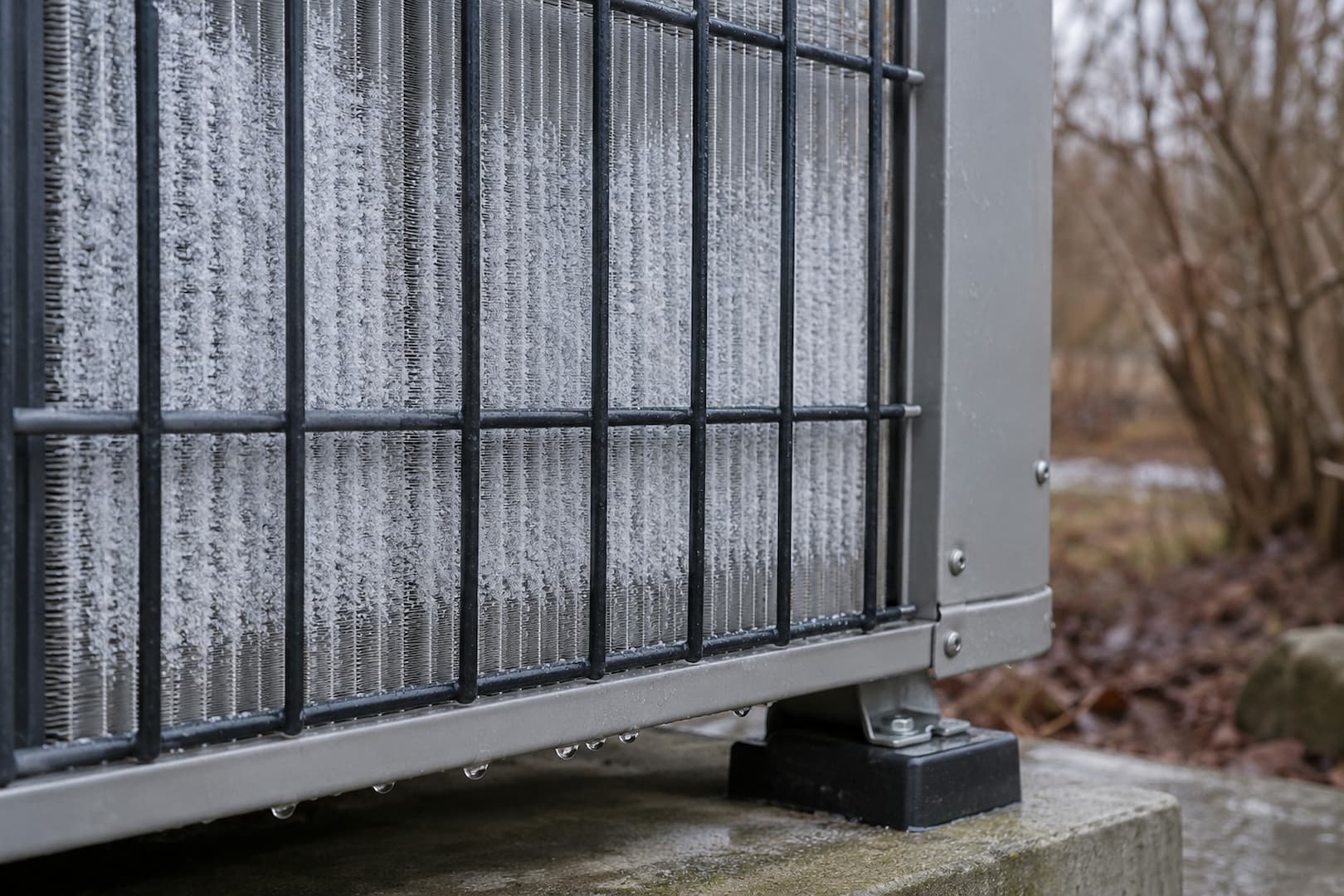
A light layer of frost on the outdoor coil can be normal in heating mode. During defrost, the system temporarily changes refrigerant operation to warm that coil. Electric backup may help keep the supply air comfortable while this happens. You might notice a brief change in sound or a cloud of water vapor outside, followed by normal heating.
Watch whether the frost clears. As Trane’s homeowner guide explains, ice that remains on the outdoor unit needs attention. A solid coating that keeps growing is different from a temporary film of frost. Do not chip the coil, pour hot water over it, or try to force defrost by altering wiring.
What to check when AUX heat stays on
How long AUX stays on is only part of the picture. Backup that runs during the coldest part of a winter night can be doing its intended job. Backup that suddenly runs through a mild afternoon at an unchanged setpoint deserves investigation. Start by establishing what changed.
- Read the actual room temperature and the setpoint. Record both, along with the outdoor temperature and when AUX appears. Note whether the room is warming, holding steady, or cooling. A photograph of the display avoids relying on memory.
- Confirm the operating mode. Check that the thermostat is in Heat and that nobody has selected Emergency Heat. Review the recent schedule or app changes. Leave installer menus and lockout settings to someone who can verify the equipment configuration.
- Inspect the accessible filter. Follow the owner’s instructions to turn off the equipment before handling it. Replace a dirty disposable filter with the correct size and approved type. Do not remove equipment panels to search for a filter.
- Look for airflow obstructions. Open supply registers and move furniture away from return grilles. From a safe position outside, check for snow or debris blocking the unit. Keep hands and tools away from the fan and electrical parts.
Trane’s heat-pump troubleshooting guidance identifies thermostat settings and restricted airflow as common things to check. These observations can narrow the problem, but a clean filter does not prove that the compressor or backup heater works correctly.

Keep a short record across comparable conditions if the home remains comfortable: the same morning schedule, a similar outdoor temperature, and the same setpoint. If you change the schedule, filter, and several control settings together, it becomes much harder to tell what helped. One clear observation is worth more than a long list of thermostat adjustments.
Judge comfort by the room temperature, not only by putting a hand over a vent. Air from a heat pump can feel less hot than furnace air while still warming the house. A fan set to On can also circulate air between heating calls. Conversely, warm air at one register does not prove every room receives enough airflow. Note which rooms fall behind and whether doors or furniture change the pattern.
Arrange prompt professional help if the house continues losing heat, the outdoor unit remains heavily iced, or breakers trip. Do not keep resetting a breaker. For a persistent electrical burning smell, stop using the equipment if you can safely switch it off and obtain urgent help; smoke or fire calls for evacuation and emergency services. If you smell gas, leave the building without operating switches and contact your gas utility or emergency services from a safe distance outside. Emergency Heat is not a workaround for an unsafe condition.
Do not disable auxiliary heat by disconnecting wires or changing an unfamiliar installer setting. That may leave the house unable to hold its temperature during a cold spell or interfere with the intended defrost sequence. If the heat pump has failed and there is no electrical, smoke, or gas hazard, consult the owner’s instructions or an HVAC professional about using Emergency Heat temporarily. Confirm that the backup actually produces heat; selecting the mode cannot fix a failed backup heater.
How much does auxiliary heat cost?
Electric resistance backup usually costs more to deliver the same amount of heat than an efficiently operating heat pump. But “AUX costs twice as much” is not a dependable estimate. Your heater capacity, the stages that actually run, operating time, and electricity tariff determine the charge. Gas-furnace backup needs a separate comparison based on fuel price and furnace efficiency.
For electric heat strips, estimate the energy charge this way: active heater kW × actual hours energized × your marginal electricity price per kWh. The U.S. Energy Information Administration explains kWh as power used over time. Use the supply and delivery charges that increase with each additional kWh on your own bill; a fixed monthly customer charge does not increase because AUX ran.
For a hypothetical example, assume 10 kW of strips actually operate for a combined two hours and the applicable variable electricity price is $0.25 per kWh. The calculation is 10 × 2 × $0.25 = $5 for the strips. That is an illustration, not a New Jersey rate quote or a forecast of your bill. Compressor and blower electricity would add to the total when they run.
Staging matters. A 10 kW installed heater does not necessarily draw its full rating whenever the display says AUX, and a thermostat’s status screen may show a heating call rather than measured electrical consumption. Ask the contractor to identify the installed capacity and the active stages before using nameplate power to estimate a month of use.
What a contractor should check before recommending changes
Ask the technician to confirm which components run when AUX appears. The technician should verify the thermostat’s equipment type, backup-fuel selection, staging, outdoor sensor, and lockouts against the manufacturer’s instructions. A recent thermostat replacement is especially relevant information to provide.
The technician should measure airflow and check the filter, coils, refrigerant operation, and defrost performance. Where electric strips are installed, the technician can verify which stages energize and whether their current draw matches the expected output. Trane’s professional maintenance checklist includes airflow, refrigerant, sensors, electrical controls, and defrost checks. Homeowners should not open electrical compartments or test high-voltage heater circuits themselves.
Ask for the findings in practical terms: was backup needed because of outdoor conditions, called unnecessarily by a control, or covering for an equipment fault? Those answers lead to different work. A thermostat adjustment will not restore a failed compressor, and replacing an outdoor unit will not automatically correct an undersized return duct.
Planning a heat pump replacement in New Jersey
Frequent AUX use alone is not proof that you need a larger system. Before replacement, compare the home’s calculated heating load with the proposed heat pump’s capacity at the local winter design temperature. Ask how much backup the design needs and how the controls will manage it. Also discuss the existing ducts and electrical capacity.
A cold-climate designation is useful evidence of low-temperature performance, but it does not size the system for your home. ENERGY STAR’s cold-climate criteria include tests at 5°F. The equipment’s detailed capacity data and the house’s load still need to be considered together.
City Ventilations handles heat pump installation and heat pump replacement for Monroe Township and surrounding Central New Jersey communities. For a planned replacement, request an estimate and bring your equipment model numbers, comfort concerns, and any record of recurring AUX operation. That gives the installation discussion a clearer starting point.
